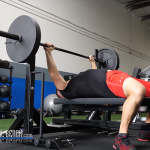
3 Keys to Long-Term Bench Press Success
August 29, 2010 by Mike Westerdal
Filed under Bench Press, Powerlifting, Recent Posts, Training
Guest post by Mike Robertson
There are times when bench press training can feel like an exercise in futility.
I’m definitely not the best bench presser to ever walk the face of the Earth. While my squat and deadlift were always quick to go up, I always struggled with the bench press.
With that being said, I’m constantly reminded of a quote from Brad Gillingham. While I may mix up the numbers, the gist of the quote stays the same:
“If you start with a 200-pound bench press at the age of 20, if you only increase your bench press by 10 pounds every year, you’ll be a 400-pound bench presser by the time you’re 40.”
That little quote has always kept me motivated to keep pressing.
But as we get older, injuries start to creep up. It could be sore and achy joints, or the occasional muscle pull. But if we want to get that consistent 10 pounds every year, then staying healthy is key.
If our goal is to stay healthy and bench press heavyweights for extended periods of time, they are three key areas of the body that we must focus on. Those three areas are:
#1 – The thoracic spine
#2 – The scapula
#3 – The rotator cuff
Let’s examine how efficient training of each of these areas can not only keep you healthy, but keep your numbers going up for years to come.
The thoracic spine
The thoracic spine may still be one of the most misunderstood areas of the human body. As powerlifters, we’re taught to rely on the strong muscle of our lower back. However, if our goal is to not only maximize performance, but to minimize injury, we must improve the extensibility of our thoracic spine.

If you watch any elite level bench presser, chances are they have a high degree of thoracic extension, which leads to a solid setup and big arch. If you’re forced to get all your extension from your lumbar spine, you’ll not only lose some of your arch but you’ll probably suffer from low back pain as well!
The easiest way to improve thoracic extension is to drive thoracic extension on either a piece of PVC pipe, or a foam roller. The exercise is simple: lay the pipe or roller perpendicular to your body around the area of your mid back. Once set up, place your fingertips behind your head and pull your elbows together in front of your face.
Gently brace your stomach, and slowly wrap your upper back around the roller or pipe. Hold for 5 to 10 seconds, and then slowly work the roller up and down your upper back.
This exercise is effective whether it’s used pre-workout, post-workout, or simply throughout the day to loosen up your upper back. Not only will better thoracic extension spare your lumbar spine, but it will also improve your upper extremity biomechanics as well. This simple tip could be the difference between a healthy body and jacked up shoulders or elbows.
The Upper Back
Once thoracic extension is in place, it’s now time to lay the foundation for a big bench press. In this case, a thick and stable upper back will allow you to maximize your bench press poundage’s.
The key, however, is not only maintaining stability through your upper back, but to build strength and mass as well.
When setting up to bench press, the name of the game is stability. The upper back is crucially important, and we need stability in both scapular retraction (pulling the shoulder blades together), as well as scapular depression (pulling the shoulder blades down).
Basic stabilization exercises such as prone I’s, prone T’s, and prone Y’s may not look like much at first blush. However, these exercises focus on recruiting the appropriate musculature to stabilize our scapula. Far too often, we’re forced to use big, prime mover muscle groups to not only produce motion, but prevent it as well.
Instead, our goal should be to strengthen our stabilizers so they are on par with our prime movers. When we do this, we allow our prime movers to do the job they’re best at – move heavy weights!
Once we build the basic stability with low-level activation and recruitment exercises, it’s time to really focus on strength and muscle mass throughout the upper back.
We know that big, compound movements are ideal when it comes to building muscle mass. However, we need to develop strength both in horizontal pulling movements, as well as vertical pulling movements.
Exercises such as chest supported rows, dumbbell rows, and low cable rows are fantastic for building width through the upper back, as well as strength and stability in scapular retraction.
When rowing, think about pulling through your elbows, and squeezing your shoulder blades together. Dorian Yates used to say that if you can’t hold the midpoint contraction for a second or more, you are simply using momentum to lift the weight. This couldn’t be truer in our case, as a maximal bench-press often lasts anywhere between five and 10 seconds. You need that maximal contraction.
Instead of massaging your ego with ridiculous poundage’s, make sure to use the appropriate muscles, and really focus on squeezing at the midpoint of each repetition.
In contrast, chin-up and pull-up variations are ideal for not only training scapular depression, but also for building our lats. The lats are critical for controlling the weight, as we will use to help actively pull the bar down to our chest when bench pressing. This “active” pulling helps maintain our stability and control on the negative portion of the lift.
Much like the row, we still need to focus on pulling through the elbows to initiate the contraction on vertical pulls. However, at the bottom, instead of pulling the shoulder blades together, we should be focused on actively pulling them downwards. Pavel describes this as pulling your shoulder blades into your back pocket. This is the essence of scapular depression, and it’s something that many trainees often struggle with.
The Rotator Cuff
The rotator cuff is the final piece of our puzzle. While many of us know that the rotator cuff is important, far too often rotator cuff training is quickly forgotten. Rather than taking a few extra minutes at the end of a session to train the rotator cuff, we leave it as an afterthought and figure we’ll get to it the next work out.
Exercises that emphasize the pecs and lats strengthen the internal rotators of the shoulder. To help maintain muscular and structural balance at the shoulder joint, we need to incorporate external rotation work in our programs.
Standrard exercises such as external rotations on the knee, or side-lying external rotations can get us started. However, I also like bigger bang exercises such as face pulls where we not only train external rotation of the shoulder, but we also get some upper back strength/stability as well.
Bringing it all together
One of the best times to get healthy and lay a better foundation is the off-season. Here are some simple tips to help regain structural balance, and put you in an optimal position to start training for your next meet or competition.
First and foremost, start your upper body workouts with a heavy pulling movement first. If you’re used to always pressing first, leading off with a pull-up or rowing variation will allow you to get more out of these exercises. You won’t be as fatigued as you normally are, and you’ll be surprised at how much more energy you have to train these lifts. With my powerlifters, we’ll often do this for the first 2-3 months of their off-season just to make sure we’re putting an emphasis on upper back strength and stability.
Along those same lines, the off-season is an ideal time to place an emphasis on all the little guys such as our rotator cuff, our scapular stabilizers, etc. Remember, the little guys are important for stabilizing the joint, and allowing the prime movers to do what they do best – move heavy weights. If we don’t bring our stabilizers up to par, we’re never going to see improvements in our primary lifts.
Summary
Whether your goal is to set a PR in your next powerlifting meet, or just be the biggest bench presser in your gym, the tips above can help take you to the next level.
Take a few weeks (or months) and build them into your next training cycle. I promise, you won’t be disappointed with the results.
About the Author
Mike Robertson has helped clients and athlete from all walks of life achieve their strength, physique and performance related goals. Mike received his Masters Degree in Sports Biomechanics from the world-renowned Human Performance Lab at Ball State University.
Mike is the president of Robertson Training Systems, where you can find tons of free blogs, podcasts, and even register for Mike’s free newsletter.
Mike is also the co-owner of Indianapolis Fitness and Sports Training, which was recently named one of America’s Top Ten Gyms.
Replay 90-Minute Coaching Call
August 9, 2010 by Mike Westerdal
Filed under Interviews, Nutrition, Powerlifting, Recent Posts, Supplements, Tangents, Training, Workout Motivation
Coaching Call with Powerlifter Mike Westerdal,
Pro Strongman Elliott Hulse & “The Muscle Cook” Dave Ruel

In this 90-Minute Coaching Call, Mike, Elliott and Dave reveal:
- How they approach training respectively for powerlifting, strongman, and bodybuilding
- What is “Powerbuilding” and how it can help you get better results
- Their foolproof methods to be successful with your goals when you’re a beginner
- How to get rid of stubborn mid-section bodyfat and finally get a six pack
- How to work around an injury
- The best ways to live longer, stronger and healthier, and what to do to promote “anti-aging”
- The truth about the relation between muscle strength and muscle size
- What is the best: Krill Oil or Fish Oil?
- How to avoid muscle soreness
- The best type of cardio (HIIT or long moderate cardio?)
- How to approach calorie rotation in your diet
- And much more…
Elliott is a riot isn’t he? Leave your comment below!
PowerBuilding Audio With Mike Schwanke
August 9, 2010 by Mike Westerdal
Filed under Interviews, Nutrition, Powerlifting, Recent Posts, Training
I just put up this new PowerBuilding audio interview with Mike Schwanke. Mike is a training partner of mine at Tampa Barbell and he’s a pro division powerlifter.

You’ll like it because Mike is super lean and strong at the same time and shares his cardio/conditioning schedule.
A lot of people ask how much cardio is too much when you are trying to stay strong so this should shed some light on the topic.
By the way did I mention Mike weighs 220 lbs and has squatted 1000 lbs, benched 700 lbs and deadlifted 800 lbs in competition! So you’ll definitely want to listen to Mike’s tips.
Got something to add to the discussion? Leave your comment below on how to balance strength with low to moderate body fat levels.
Redskins DE Phillip Daniels Opens Monster Garage Gym
August 24, 2009 by Mike Westerdal
Filed under Interviews, Powerlifting, Recent Posts, Training
Friday night is a big night for me, there’s a lot on the line. Actually I’m not leaving the house but I made a bet with my wife. She’s a huge Patriots fan and I’m a hardcore Redskins fan. It’s just preseason but our teams face each other this Friday.
The veterans don’t have a lot at stake, but as for me, well if the Pats win I’ll never hear the end of it.
One my favorite players is the NFL is Phillip Daniels who is a DE with the Washington Redskins going into his 14th season.
This guy is an Ox! Other than the fact that he slams QBs to the ground and is one of the best run-stuffers in the League, Phil is also an offseason Powerlifter.
I got him on the line to talk with us about a hardcore gym that he just opened up.
It’s called Monster Gargage Gym located in IL and he opened it with co-owner and 2 time WPC powerlifting champ Eric Maroscher.
As a skins fan, fellow powerlifter and the fact that I train at a barbell club and warehouse gym myself I definitely want to help get the word out about this new facility.

Some of today’s fitness centers just make me sick, so I’m happy every time I hear about one of these underground barbell clubs opening up.
Enjoy the interview….Phil is a real down to Earth guy and you’re gonna love his energy.
Go Skins!
Mike Westerdal
(Fan since the 5th grade)
P.S. Why am I Skins fan when I live in Tampa Bay? Because I was born in raised in northern VA and because I like watching them destroy the Bucs! That’s right, I said it!
Chris Janek Totals 2502 At Only Third Powerlifting Meet
June 16, 2009 by Mike Westerdal
Filed under Interviews, Powerlifting, Recent Posts
Chris Janek competed in the 2009 UPA Powerlifting Nationals held in Dubuque, IA – April 2009

Chris Janek (308) represented Critical Bench totalling 2,502 pounds in only his third meet. Janek squatted 1,036 pounds, benched 727, and deadlifted 738 pounds.
Luke Allison of Critical Bench interviews Janek in this podcast discussing the meet and training leading up to the meet.
To get your Chris Janek desktop Wallpaper visit this page for more screen resolutions.
http://www.criticalbench.com/free-muscle-wallpapers.htm