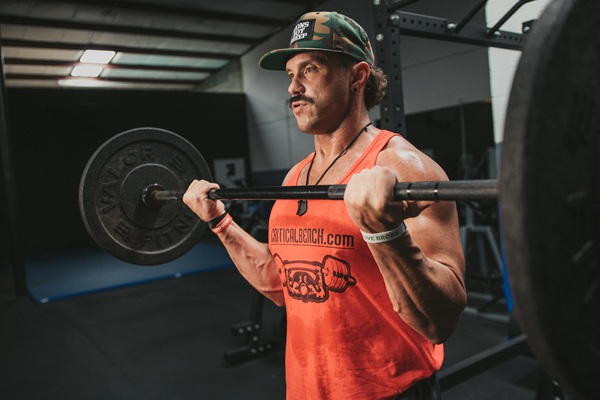
If you want to build muscle, get stronger, and develop a more powerful athletic body, you don’t need a gym full of complicated machines and a workout packed with dozens of exercises.
Sometimes, you just need a barbell.
According to Coach Frank Rich of the CriticalBench Compound, there are five fundamental barbell exercises that can give you everything you need to train your entire body. These aren’t flashy exercises or obscure movements you’ve probably never heard of. They’re ‘the classics’ and for good reason.
The squat. The deadlift. The barbell row. The shoulder press. And the bench press.
As Frank explains, these five movements can be used with a variety of rep ranges and training goals, whether you’re focused more on strength and mass with something like 5 sets of 5 or want to incorporate higher-rep metabolic work.
“These are the five exercises that you need to learn, you need to master, and you need to execute.”
And the best part? You can perform all five with nothing more than a barbell and the appropriate amount of weight.
Watch Coach Frank Rich break down all five exercises in the video below:
Now let’s break down each movement and the key points Frank wants you to know.
1. Barbell Squat
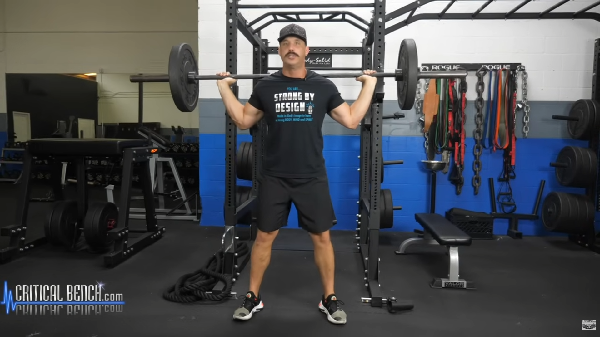
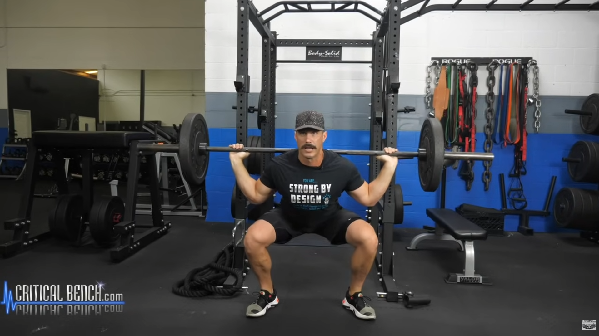
Let’s start with the king of lower-body exercises: the barbell squat.
The squat is a foundational movement for developing the entire lower body, including the quads, hamstrings, and glutes. It also requires you to brace your core and maintain control throughout the movement.
Frank recommends finding a comfortable, relatively neutral foot position. Your exact stance will depend on things like your hip width and leg length, so don’t worry about forcing your feet into one specific position.
The goal is to find the stance that allows you to squat comfortably and safely.
How to Perform the Barbell Squat
- Position yourself securely underneath the bar and establish a comfortable hand placement.
- Lift the bar from the rack and step back into your squat position.
- Find a comfortable, relatively neutral foot stance.
- Brace your core and maintain a strong, tight torso.
- Break at the hips and bend the knees as you lower yourself.
- Descend under control and use a slight pause at the bottom if appropriate.
- Drive back up to the starting position.
- Breathe in on the way down and breathe out as you come back up.
Coach Frank’s Key Point
Don’t get overly caught up in trying to copy someone else’s exact stance.
Your body is different.
Your hip structure, leg length, and overall build will influence what feels natural. Find a comfortable position that allows you to execute the movement safely and consistently.
Training at Home Without a Rack?
Frank also demonstrates an option for people training at home who don’t have a squat rack.
With the bar loaded appropriately, you can clean the bar up to your shoulders and get it into position before performing your squats.
Obviously, this is not the approach you want to take with a maximal load. Keep the weight manageable and make sure you can safely get the bar into position before attempting the exercise.
2. Barbell Deadlift
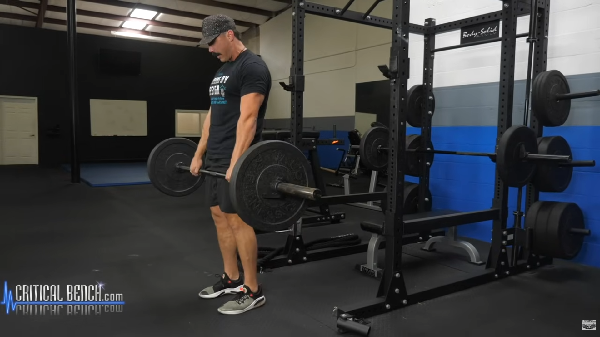
Next up is the deadlift, or as Frank describes it, your hip-hinge movement.
This exercise is a powerhouse for the posterior chain, training the hamstrings, glutes, lower back, and spinal erectors, while also requiring your entire body to work together.
Unlike a stiff-legged deadlift, the movement Frank demonstrates uses a slight bend in the knees while emphasizing the hip hinge.
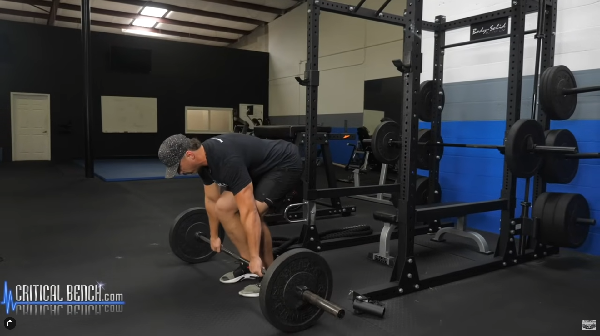
How to Perform the Barbell Deadlift
- Begin with the bar positioned on the floor.
- Set your feet in a relatively neutral, approximately shoulder-width position.
- Bend your knees and lower your hips toward the bar.
- Establish your grip.
- Brace your core and lock your body into a strong starting position.
- Keep your legs secure against the floor.
- Hinge through the hips as you begin the movement.
- Drive your hips forward as you come to standing.
- Finish by squeezing the glutes and maintaining control.
Frank demonstrates a false grip in the video, explaining that he prefers it because it encourages him to rely more on his back to brace the movement rather than his arms. However, he also notes that a traditional thumbs-under grip is perfectly fine if that’s what you’re comfortable using.
Coach Frank’s Key Point
Brace your core.
Frank repeatedly emphasizes keeping the core locked throughout the movement.
Think about creating tension before you move the bar. You’re not simply picking a weight up off the floor. You’re bracing your entire body, hinging at the hips, and driving those hips forward.
3. Barbell Row
Now we’re moving from the lower body to the back.
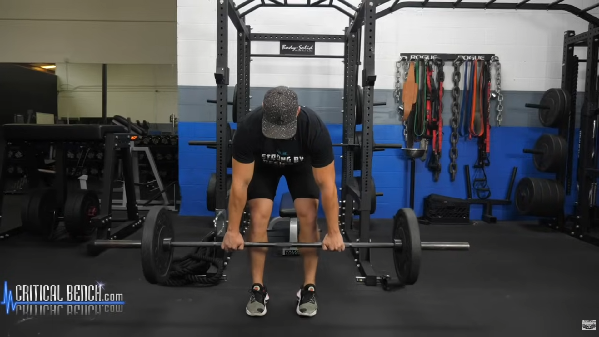
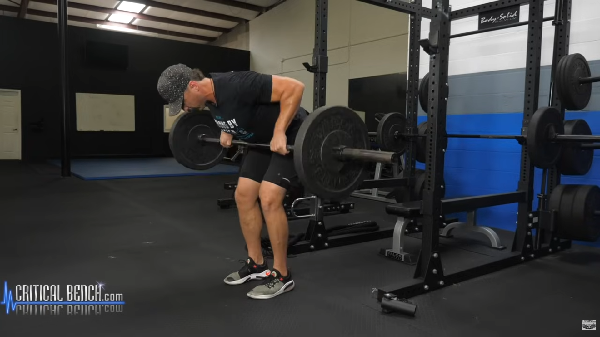
The barbell row is Frank’s primary pulling movement for building the back, and it also brings the biceps and forearms into the equation as secondary movers.
This is another great example of why you don’t necessarily need a bunch of isolation exercises to train your arms.
When you’re performing big compound movements correctly, your arms are already doing plenty of work.
How to Perform the Barbell Row
- Start with the bar positioned on the floor.
- Establish a comfortable, neutral foot position.
- Grab the bar with your preferred grip.
- Lift the bar into position while keeping your chest controlled and your core engaged.
- Maintain your body position as you row the bar toward your midsection.
- Squeeze your upper back at the top of the movement.
- Lower the bar under control.
- Repeat while maintaining tension throughout the movement.
Coach Frank’s Key Point
Don’t just move the bar from point A to point B.
Feel the contraction.
Frank emphasizes squeezing the upper back and really focusing on the muscles working throughout the movement.
The goal isn’t simply to yank the bar toward your body. Control the movement and make your back do the work.
And once again, your biceps and forearms are getting some work without needing a separate arm exercise.
4. Standing Barbell Shoulder Press
The fourth exercise takes us overhead: the standing barbell shoulder press.
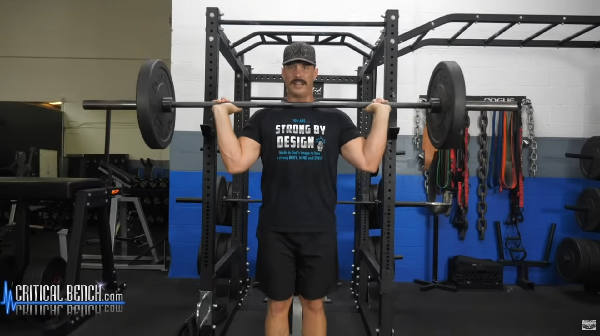
Frank performs this movement standing rather than seated, which brings more core engagement into the exercise because your legs and torso have to help stabilize your body.
The primary focus is the shoulders, particularly the front and medial delts, while the triceps and upper chest contribute as secondary movers.
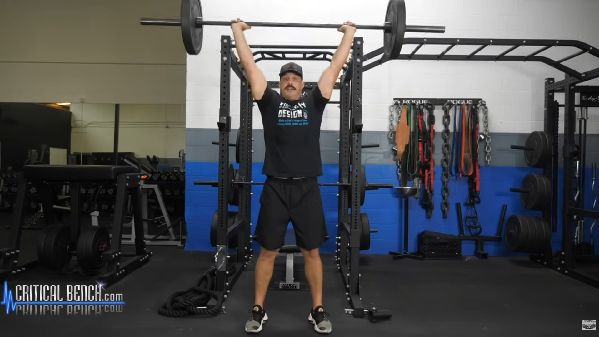
How to Perform the Barbell Shoulder Press
- Position the bar at approximately shoulder height.
- Establish a comfortable, neutral hand position.
- Keep your feet secure and maintain a slight bend in the knees.
- Brace your core and prepare your body before pressing.
- Press the bar overhead under control.
- Slowly lower the bar back toward the starting position.
- Repeat while maintaining control and proper breathing.
Frank recommends avoiding an excessively wide or narrow grip. A grip that’s too wide can limit your range of motion, while going too narrow can create unnecessary strain on the joints.
He also points out that many barbells have markings that can help you establish a consistent hand position.
Coach Frank’s Key Point
Don’t lock your knees.
Frank keeps a slight bend in his knees while standing and emphasizes keeping the legs secure to provide support throughout the movement.
And, as always, breathe. Don’t hold your breath unnecessarily throughout the entire set.
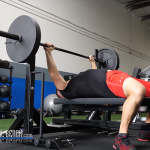
5. Barbell Bench Press
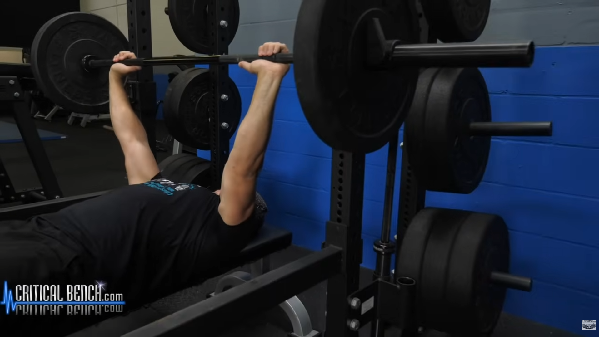
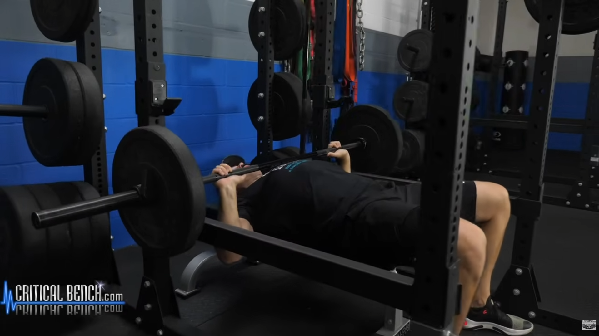
And finally, we have one of the most recognizable barbell exercises of all time: the bench press.
The bench press primarily trains the chest while also bringing the front delts and triceps into the movement.
Frank’s setup is straightforward: establish a secure position on the bench, keep your feet planted, maintain a slight natural arch through the lower back, and keep your glutes firmly on the bench.
How to Perform the Barbell Bench Press
- Lie on the bench and establish a secure position.
- Plant your feet firmly on the ground.
- Keep your back flat against the bench with a slight arch through the lower back.
- Keep your glutes in contact with the bench.
- Establish a comfortable, neutral grip on the bar.
- Press the bar from the rack.
- Breathe in as you lower the bar.
- Lower the bar toward the middle of your chest.
- Touch the chest if you can do so comfortably and safely.
- Press the bar back up while breathing out.
How Low Should You Go?
This is one of the more important points Frank makes during the bench press demonstration.
Don’t force a range of motion that you can’t perform comfortably and safely.
If you can comfortably bring the bar to your chest, great.
If your range of motion currently stops short of that, that’s okay too.
The goal isn’t to impress someone standing next to you in the gym. The goal is to perform the exercise safely, consistently, and with good control.
What Makes These Five Exercises So Effective?
Look at what we’ve covered:
- Squat — lower body
- Deadlift — posterior chain
- Barbell Row — back and pulling muscles
- Shoulder Press — shoulders and pressing muscles
- Bench Press — chest and pressing muscles
Together, these five compound movements give you a tremendous amount of training stimulus with one simple piece of equipment: a barbell.
And because these are compound movements, you’re training multiple muscle groups at the same time rather than relying on a long list of isolation exercises.
That’s really the philosophy behind Frank’s approach.
You don’t need to make training complicated.
You need to learn the fundamental movements, master your technique, choose an appropriate weight, and execute them consistently.
What About Sets and Reps?
Frank points out that these exercises can work across a variety of rep ranges.
For someone focused on strength and muscle building, something like 5 sets of 5 can be an effective approach.
If you’re looking to incorporate higher-rep metabolic work, you can increase the reps into the 10–12 range.
The important caveat is that as your reps increase, you still need to maintain proper form and execution.
More reps don’t give you permission to get sloppy.
Start With the Basics. Then Get Stronger.
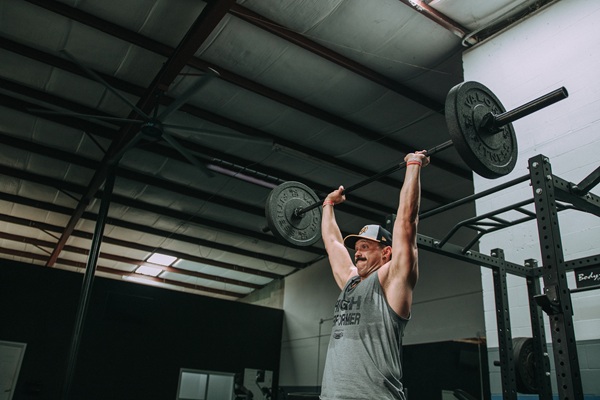
There’s a reason these exercises have stood the test of time.
You don’t need a dozen machines, complicated supersets, or a different exercise for every individual muscle fiber.
Learn how to squat.
Learn how to deadlift.
Learn how to row.
Learn how to press overhead.
Learn how to bench press.
Then get progressively better at them.
As Coach Frank says, if you’re relatively new to training, especially during those first year or two—these are five movements worth learning, mastering, and consistently executing.
Master the basics first.
Then build from there.
And if you want to take these five foundational movements and expand your exercise arsenal with more classic bodybuilding techniques, check out 101 Pro Bodybuilding Tips, featuring exercises and training ideas inspired by bodybuilding legends like Arnold Schwarzenegger, Sergio Oliva, Frank Zane, and Larry Scott.
Because sometimes the best way to build a better body isn’t to make your training more complicated.
It’s to get really, really good at the basics.