|
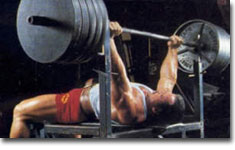 As the title of this week’s column indicates, the bench press has achieved almost cult status, reaching even into popular culture. It wasn’t always this way— prior to the 1960’s the most popular upper body lift was the military press— at that time, one of the three lifts contested in the sport of weightlifting (the press was removed from competition in the early 1970’s due to fears that lifters were using dangerous lifting postures in the attempt to press larger and larger weights). As the title of this week’s column indicates, the bench press has achieved almost cult status, reaching even into popular culture. It wasn’t always this way— prior to the 1960’s the most popular upper body lift was the military press— at that time, one of the three lifts contested in the sport of weightlifting (the press was removed from competition in the early 1970’s due to fears that lifters were using dangerous lifting postures in the attempt to press larger and larger weights).
Despite the fact that men tend to turn this lift into a demonstration event, and that women tend to shy away from the lift altogether, bench pressing (and it’s variations) remain the premier upper body development tool for physique and strength enthusiasts. Like any tool, used properly, you’ll get a great result; done improperly, then bench press can tear up shoulders like nobody’s business. here are my suggestions for safe and effective bench pressing:
Bench presses may be performed with a bar or with dumbbells. The bench may be flat (overall pectoral stress), inclined (more stress to the clavicular pectorals), or declined (more stress to the lower pectorals). Lay on the bench, placing both feet flat on the floor (if this causes the curvature of your low back to increase, find a lower bench or place your feet on solid blocks to elevate them). Grasp the bar such that both hands are equidistant to the center, and make sure your thumbs are wrapped around the bar, rather than on the same side as your other fingers. You only have to drop a big weight on your chest one time to become convinced that a thumbless grip is a big mistake (assuming you survive it).
Although it is difficult to articulate this concept in writing, the shoulder blades should be tucked together prior to unracking the bar. Do this while your hands are on the bar— lean to your right side and pull the left scapula inward, and then put your weight down on it. Then, leaning on your left scapula, tuck your right side in and then center your bodyweight. When the scapulae are tucked (retracted), the shoulder joints will be afforded additional range of motion as the bar descends, thus adding a measure of safety to the lift.
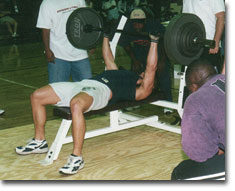 Immediately prior to unracking, the bar should be directly over your nose—if it isn’t, slide yourself up or down on the bench until it is. Inhale and unrack the bar from the supports. Pause in the top position for a brief moment, rather than making a “B-line” from the supports to your chest. At this time, take in as much air into your lungs as possible and hold until the bar has ascended through the sticking point. Why? Ever notice that great bench pressers have “barrel” chests? This gives the pecs better leverage. You can give yourself a temporary, artificial barrel chest by inhaling as deeply as possible and holding throughout the lift. Immediately prior to unracking, the bar should be directly over your nose—if it isn’t, slide yourself up or down on the bench until it is. Inhale and unrack the bar from the supports. Pause in the top position for a brief moment, rather than making a “B-line” from the supports to your chest. At this time, take in as much air into your lungs as possible and hold until the bar has ascended through the sticking point. Why? Ever notice that great bench pressers have “barrel” chests? This gives the pecs better leverage. You can give yourself a temporary, artificial barrel chest by inhaling as deeply as possible and holding throughout the lift.
As you lower the bar to your chest, keep your elbows directly under the bar, rather than in front of, or ahead of the bar. At the bottom of the movement, the bar lightly touches your chest at nipple level. Return the bar to the starting position (it should actually travel up, as well as slightly back) by contracting your pectorals.
(Note: there are in fact many different variations regarding grip width, elbow position, and contact area on the chest. The variation I’m describing here is intended for muscular development more so than maximum bench press strength. Competitive powerlifters use an array of techniques designed to maximize leverage, but I assume readers who are also competitive powerlifters will already be familiar with these techniques).
Grip Width
Viewed from the head of the bench, your forearms should be perpendicular to the floor at the bottom position.
Torso
Keep your torso flat on the bench at all times— the bench press is not intended to be a hamstring exercise, despite my sarcastic article called Bench Pressing: The Forgotten Hamstring Exercise
(located at:
|